How Trade Media Investment Correlates with Superior Financial Performance in the Electrical and Automation Sector
May 14, 2026
By JOHN KERR
A study of 27 publicly traded companies in the electrical and automation sector reveals a striking correlation between investment in trade media advertising and share price performance. Over the five-month period from January 1 to May 13, 2026, companies that advertised in trade channels delivered an average gain of +45.2% — compared with +17.6% for non-advertisers. That 27.6 percentage-point gap dwarfs both the TSX Composite (+7.3%) and the Dow Jones Industrial Average (+3.4%) over the same period. This article examines what the data tells us, why it matters regardless of whether your company is publicly traded, and what the implications are for marketing investment strategy in this sector.
The Question Every Marketing Budget Owner Should Be Asking
Every spring, marketing budgets come under review. In the electrical and automation sector where product cycles are long, buying decisions involve multiple stakeholders, and brand equity is built over years, not quarters — the temptation to trim trade media spend in favor of short-term digital tactics is real and recurring.
But what if the financial markets have already answered the question?
In early 2026, Kerrwil Research undertook an analysis of 27 publicly traded companies operating in the electrical and automation space. The study examined one variable: whether each company had maintained active investment in trade media advertising. The share price performance of the two groups over the same five-month window was then compared — alongside two of the most widely followed market benchmarks, the TSX Composite and the Dow Jones Industrial Average.
The results were not marginal. They were not coincidental. They were by any standard of business analysis significant.
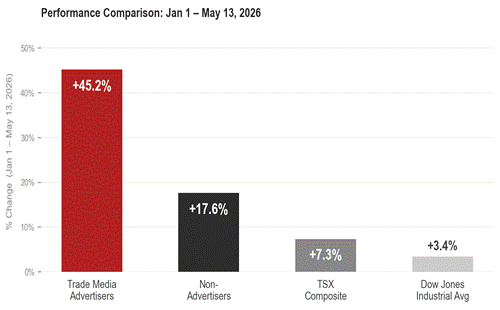
Figure 1: Average share price gain by group, January 1 – May 13, 2026
The Numbers: A Study in Two Groups
Of the 27 companies analyzed, 14 were identified as active trade media advertisers and 13 were not. The split was determined based on observed advertising activity within recognized trade channels serving the electrical, automation, and related B2B sectors.
The findings, summarized below, speak directly to the value of sustained trade visibility:
| Group | Avg Gain | Median | Winners | Best Performer |
| Trade Media Advertisers (n=14) | +45.2% | +47.6% | 12 of 14 | +117.7% |
| Non-Advertisers (n=13) | +17.6% | +14.3% | 12 of 13 | +79.3% |
| TSX Composite Index | +7.3% | — | — | — |
| Dow Jones Industrial Average | +3.4% | — | — | — |
Table 1: Summary performance by group, January 1 – May 13, 2026
The advertiser group outperformed non-advertisers by 27.6 percentage points on average. It outperformed the TSX Composite by nearly 38 percentage points and the Dow Jones by over 41 percentage points. Among advertisers, 12 of 14 companies recorded gains. Among non-advertisers, 12 of 13 also gained — but at a fraction of the pace.
Reading the Distribution: It’s Not Just the Averages
Averages can be misleading, particularly when a single high-performing outlier skews the result. For that reason, it is worth examining the full distribution of outcomes across both groups.
The top performer among advertisers gained +117.7% over the period. The best non-advertiser result was +79.3% — a strong showing, but achieved by a single company; the cluster of non-advertiser returns sits predominantly in the +8% to +27% range. Meanwhile, the advertiser group shows a much stronger concentration of returns in the +40% to +70% range, with multiple companies exceeding +90%.
The median for the advertiser group was +47.6%, compared with +14.3% for non-advertisers. In statistical terms, this is a robust finding: it is not driven by outliers. The central tendency of the advertiser group is materially higher.
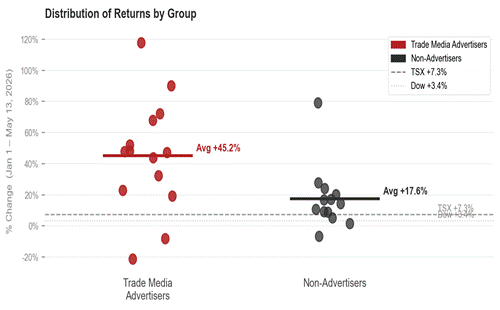
Figure 2: Distribution of individual company returns, January 1 – May 13, 2026
This distribution matters because it reinforces a key point: companies that invest in trade media visibility do not merely benefit from one or two exceptional performers lifting the group average. The outperformance is broad-based.
What This Means if Your Company Isn’t Publicly Traded
A fair question arises immediately: if your company does not trade on public exchange, why should equity market data matter to you?
The answer lies in what share price measures. For publicly traded companies, share price is the market’s continuous real-time assessment of expected future earnings, competitive positioning, brand strength, market share momentum, and leadership credibility. It is, in essence, the aggregated judgment of informed buyers and sellers on the long-term health and prospects of the business.
The same underlying value drivers apply whether a company has public equity. Margin performance, sales velocity, brand equity, and customer retention are as real for a privately held distributor or manufacturer as they are for a TSX-listed corporation. The public share price data simply makes those dynamics visible and measurable in a standardized way.
Put another way: if trade media investment correlates with superior equity market performance among publicly traded peers, it is reasonable to infer that the same investment is driving the same underlying business outcomes — margin, growth, customer loyalty — for private companies in the same sector. The stock price is the indicator. The business fundamentals are the cause.
Why Trade Media Advertising Drives Business Performance
The correlation identified in this study is striking, but it is worth examining the mechanism — why would advertising in trade channels contribute to the kind of business performance that markets reward?
Margin Protection Through Brand Preference
In commodity-adjacent product categories — and much of the electrical and automation sector qualifies — brand equity is one of the few durable sources of pricing power. Distributors, contractors, and specifiers who trust a brand are less likely to substitute on price alone. That translates directly into margin protection. Trade media advertising, sustained over time, builds and maintains the familiarity and credibility that supports premium positioning.
Sales Velocity Through Specification and Pull-Through
The electrical distribution channel is specification driven. Engineers specify products; distributors stock and supply them; contractors install them. Trade media that reaches consulting engineers, electrical designers, and facility managers creates pull-through demand that supports the entire channel. That pull-through shows up in distributor order velocity and, ultimately, in manufacturer revenue growth.
Market Intelligence and Category Presence
Companies that advertise consistently in trade publications maintain a presence in the ongoing conversation of their sector. They are visible when buyers are evaluating options, when engineers are updating preferred supplier lists, and when distributors are deciding which brands to promote. The alternative — absence from the trade media conversation — cedes that ground to competitors who are present.
Investor and Analyst Credibility
For publicly traded companies, there is a secondary effect worth noting: consistent trade media presence signals organizational health and commercial confidence to the analyst and investor community. A company that invests in its market presence is signaling that it believes in its forward trajectory. That signal, however subtle, can influence institutional sentiment.
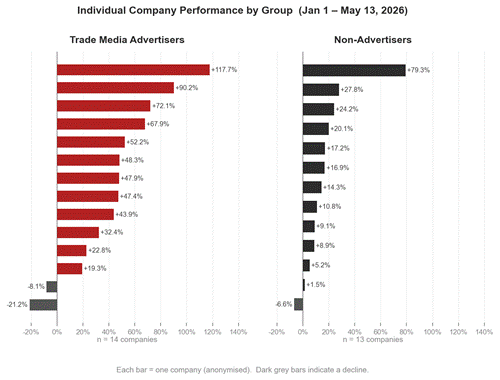
Figure 3: Individual company returns by advertiser group
The Sailing Analogy: Boat Speed Is Not an Accident
Those who follow competitive sailing will recognize the concept of boat speed — the aggregate result of dozens of small decisions: rig tension, sail trim, hull preparation, crew positioning, tactical awareness. In a one-design fleet where every boat is theoretically identical, the differences in speed come entirely from execution and preparation. A faster boat is not faster because it gets better wind. It is faster because it is better tuned.
The 27 companies in this study were sailing the same course, in the same conditions, during the same five months. The same macro environment. The same interest rate pressures. The same tariff uncertainties. The same global supply chain dynamics. The wind was identical for every one of them.
And yet the two groups separated decisively over 140 days.
Trade media advertising is part of the tuning. It is not the only variable, and no serious analyst would claim otherwise. But the data suggests it is a meaningful one. Companies that invest in their trade media presence — sustaining their brand in front of buyers, specifiers, engineers, distributors, and the buying team of influencers who shape purchasing decisions appear to achieve the kind of business momentum that markets recognize and reward.
Benchmarks in Context: What the Indices Tell Us
To put the sector findings in broader perspective, both major market indices posted modest gains over the study period. The Dow Jones Industrial Average moved from 48,063 to 49,693, a gain of approximately +3.4%. The TSX Composite advanced from 31,713 to 34,041, a gain of approximately +7.3%.
Both groups of electrical and automation companies outperformed those benchmarks. The non-advertiser group, with an average gain of +17.6%, still beat the Dow by more than five times and the TSX by more than two times. That speaks to the underlying strength of the sector broadly during this period.
But the advertiser group’s +45.2% average — more than six times the TSX and more than thirteen times the Dow — represents a level of outperformance that goes well beyond sector tailwinds. It points to company-specific factors. And one of the clearest distinguishing factors between the two groups is trade media investment.
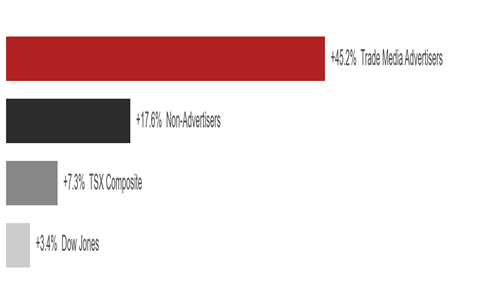
Figure 4: Performance gap — advertisers vs. non-advertisers vs. market benchmarks
Implications for Marketing Strategy
This study does not argue that trade media advertising is the sole driver of business performance — that would be overreach. The companies in both groups operate across diverse product categories, geographies, and business models. Leadership quality, product innovation, balance sheet strength, and operational execution all contribute to performance outcomes.
What the data does argue is this: among a peer group of 27 companies in the same sector, over the same market conditions, during the same five-month window, the group that invested in trade media advertising significantly outperformed the group that did not. That correlation is consistent across both averages and medians. It is not explained by a single outlier.
For marketing budget owners, the practical question is not whether to advertise — the data makes a compelling case that investment in trade visibility is associated with superior outcomes. The more useful question is: are you allocating that investment to the channels that reach the buyers, specifiers, and influencers who matter most to your business?
Trade publications that serve the electrical, automation, and distribution sectors — channels like Canadian Electrical Wholesaler, Electrical Industry, Power & Telecom, and Data Centre Digest — deliver content to the decision-makers and influencers who shape purchasing and specification decisions throughout the channel. Sustained presence in those channels is not simply a branding exercise. Based on the evidence presented here, it may be one of the more financially defensible marketing investments a company in this sector can make.
Methodology Note
This analysis examined 27 publicly traded companies operating in the electrical and automation sector. Companies were categorized as advertisers or non-advertisers based on observed trade media advertising activity in recognized B2B channels serving the sector. Share price data was sourced from public market records; January 1 values reflect December 31, 2025 closing prices where markets were closed on New Year’s Day. Performance figures are presented in local currencies where applicable and are not adjusted for currency exchange. Index data reflects publicly reported figures for the TSX Composite and Dow Jones Industrial Average. This study does not constitute investment advice.
Sources: