Q2 Non-residential Building Construction Up 1.4% over Q1
July 30, 2018
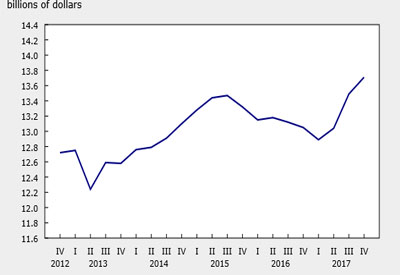
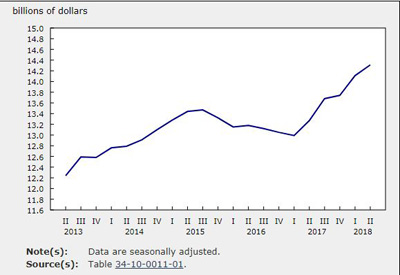
Investment in non-residential building construction totalled $14.3 billion in the second quarter, up 1.4% compared with the first quarter. The commercial (+$123.7 million) and industrial (+$103.4 million) components were up, while the institutional component declined.
Investment in non-residential building construction totalled $14.3 billion in the second quarter, up 1.4% compared with the first quarter. The commercial (+$123.7 million) and industrial (+$103.4 million) components were up, while the institutional component declined.Spending on institutional building construction was down 0.9% (-$35.3 million) compared with the first quarter. The decrease follows four consecutive quarterly gains. Nationally, the decline stemmed from lower spending on schools (-$44.3 million) and nursing homes (-$25.1 million), as well as penitentiaries, detention centres and courthouses (-$13.6 million). Hospitals, health care centres and clinics were the only building types with a quarterly increase, up $56.3 million.
Provincially, the largest decline for institutional building construction was in Alberta, down $38.0 million. Across Canada, 20 census metropolitan areas (CMAs) reported reduced spending on institutional building construction, with Edmonton (-$16.0 million) and Ottawa (-$14.9 million) showing the largest declines.
Investment was up in six provinces in the second quarter, with Ontario (+$130.6 million) reporting the largest rise, followed by Quebec (+$76.7 million) and British Columbia (+$45.6 million). Every component was up in all three provinces, led by spending on commercial building construction.
In Ontario, investment in commercial buildings rose by $83.8 million (+2.5%), led by non-residential construction. Investment in office buildings (+$78.4 million) and passenger terminal construction (+$47.2 million) were the main drivers behind the increase in the commercial component.
These gains were partially offset by lower spending on theatre and performing art centres and recreational buildings (-$21.8 million) and shopping centres
(-$21.5 million).In Ontario, 11 of the 16 CMAs posted increases in commercial spending, led by Toronto (+$91.1 million). Conversely, London (-$11.0 million) and Ottawa (-$6.1 million) reported the largest declines for the component.
All three components contributed to the quarterly increase in Quebec. Spending on commercial building construction posted the largest increase (+$45.2 million), the result of investment in theatre and performing art centres and recreational building construction (+$32.7 million), followed by investment in office building construction (+$19.9 million). Investment in Quebec was driven mostly by the Montréal CMA, which posted increases for both the commercial (+$45.8 million) and institutional (+$20.2 million) components.
In British Columbia, investments in commercial (+$25.0 million) and industrial (+$19.7 million) building construction were the primary contributors to the quarterly increase, with the institutional component essentially unchanged. The gain for the commercial component was mainly the result of spending on the construction of office buildings (+$29.0 million). The industrial component was driven by spending on manufacturing plants, up $12.5 million, and farm building construction, up $11.1 million. Investment gains were reported in three of the four CMAs in the province, led by Vancouver (+$28.7 million) and Abbotsford–Mission (+$5.6 million).
The largest quarterly decline was in Alberta (-$63.4 million), reflecting lower spending on commercial (-$42.5 million) and institutional (-$38.0 million) building construction. The drop in the commercial component was due to lower spending on theatre and performing art centres and recreational buildings (-$21.5 million), shopping centres (-$12.4 million) and passenger terminals (-$12.4 million). The instititional component was down on lower spending on schools (-$57.6 million) and nursing homes (-$15.9 million). The Edmonton CMA reported the biggest drop in spending among Alberta’s CMAs, as spending was down for both commercial (-$24.3 million) and institutional (-$16.0 million) building construction.
Source: Statistics Canada, https://www150.statcan.gc.ca/n1/daily-quotidien/180719/dq180719b-eng.htm