Your Customers Aren’t Afraid of AI — Your Employees Are
August 19, 2026
Why the real risk of agentic AI isn’t technological. It’s trust.
By Jerome Potvin · Director of Commercial Strategy · Innovair Group
For two years, “AI in the enterprise” mostly meant ChatGPT drafting an email. That era is over.
Generative AI produces content — text, an image, a reply — that someone still has to read, validate, and use. Agentic AI does something else: it takes a task, decides the steps, and carries them out itself, without waiting to be guided at every step. That’s the difference between an employee who drafts a reply, and an employee who processes the order from start to finish — unsupervised.
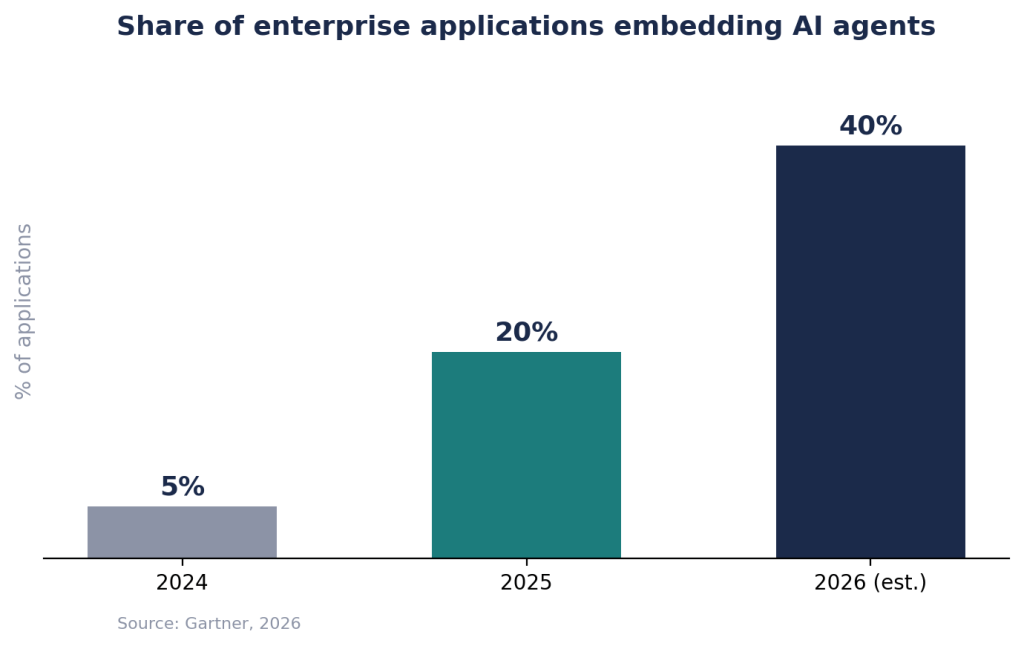
This shift is no longer theoretical. According to Gartner, the share of enterprise applications embedding autonomous AI agents has grown from under 5% in 2024 to roughly 40% this year. This isn’t a trend anymore: it’s large-scale deployment, and it’s touching real tasks — customer service intake, administrative processing, data entry, first-line technical support.
While leadership accelerates, another curve is rising in parallel: distrust. Filmmaker Christopher Nolan, in an interview promoting his latest film, captured a sentiment that goes well beyond cinema: he says he’s never seen such a fast, widespread rejection of a technology being sold as a fundamental breakthrough — and notes that even the young people around him instantly spot AI-generated content.
“I’ve never seen such a fast and massive rejection of a technology that’s being sold to us as a fundamental breakthrough.”
The paradox that will define 2026-2027
The numbers tell two opposing stories, and it’s exactly this paradox that should have the attention of any leader pushing AI adoption in their organization:
82%
of organizations are increasing AI investment this year (ServiceNow)
40%
of agentic AI projects could be abandoned by 2027 (Gartner)
66%
of companies are already cutting entry-level hiring (WEF)
340%
more resistance when concerns are ignored
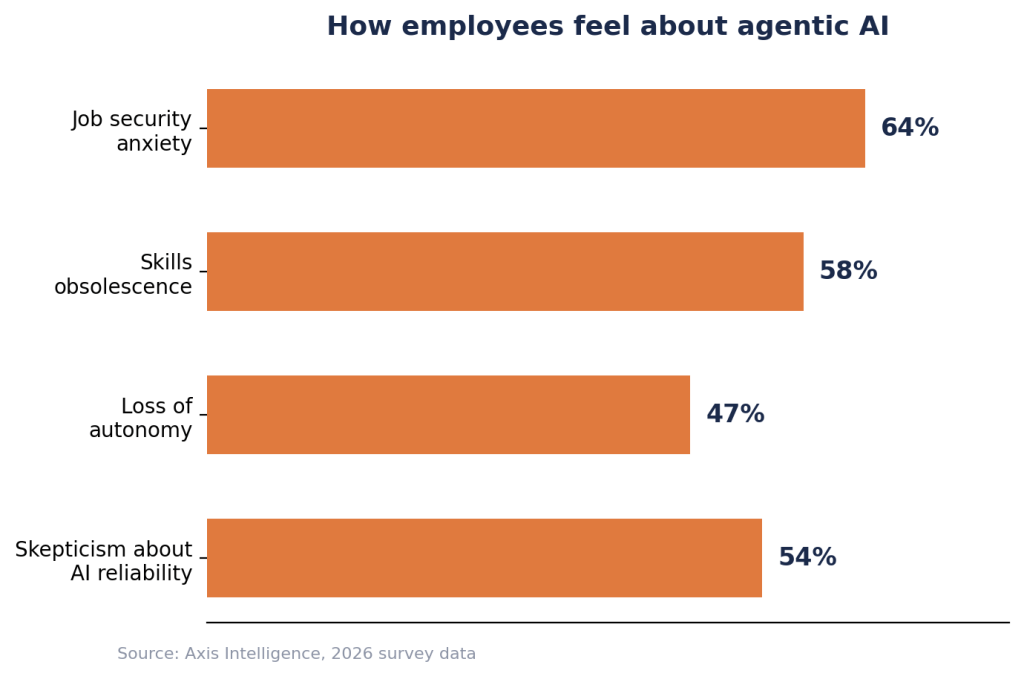
The conclusion is clear: companies that put real change management in place get 2.8 times more adoption than those that simply deploy the technology and hope for the best.
Why HVAC/electrical distribution isn’t immune
You might think this debate mostly concerns tech, call centers, or large-company administration. It doesn’t. In a distribution network like ours, several functions closely resemble the most exposed roles identified in these studies: order taking, first-line technical support, price data entry and validation, repetitive responses to product availability requests.
These are exactly the tasks where agentic AI excels today — and exactly the tasks held by employees who, rightly, are asking what this means for them. Ignoring that reality, or treating it purely as a productivity issue, is a recipe for the resistance documented above.
The real risk isn’t technological — it’s human
After several internally led AI projects, one lesson keeps repeating: technology was never the limiting factor. It’s transparency about what’s changing, for whom, and why, that determines whether a project holds — or collapses after launch.
A simple framework for deploying agentic AI without widening the trust gap:
- Name the automated tasks — not the jobs. That distinction changes everything in how the message lands.
- Involve the most exposed employees from the design stage, not just at announcement time.
- Invest in reskilling before deployment, not after the first cuts.
- Keep an explicit human role in the decision loop — visible and communicated, not just real behind the scenes.
- Measure and communicate results honestly, failures included — that’s where credibility is built.
Conclusion
The question is no longer “should we deploy agentic AI?” — the answer is already yes, almost everywhere. The real question is: will you do it with your teams, or despite them? The competitive edge of the next two years won’t go to the fastest to deploy. It will go to those who bring their employees along instead of working around them. In a sector like ours, where the human relationship remains the real competitive advantage, it’s a bet we can’t afford to lose.
Sources
- Gartner — forecast on AI agent integration in enterprise applications, 2026.
- ServiceNow, Enterprise AI Maturity Index 2025 — organizations’ AI investment intentions.
- World Economic Forum — reduction in entry-level hiring linked to AI.
- Axis Intelligence — 2025-2026 survey data on employee concerns about agentic AI and the impact of change management on adoption rates.
- The Guardian — Christopher Nolan interview on public reception of AI, July 2026.
- Anthropic, State of AI Agents Report 2026 — survey of 81,000 users on automation-related concerns by role.
Jérôme Potvin · Director, Commercial Strategy, Innovair Group