June 12, 2026
By Jerome Potvin · Director of Commercial Strategy · Innovair Group
The distributors winning today aren’t the ones with the most salespeople — they’re the ones who figured out how to make every rep act like they have a data scientist in their pocket.
For decades, channel sales ran on relationships. The best distributors won not because they had the smartest systems — but because they had the most trusted reps, the deepest rolodexes, and instincts built from years on the road. That model still matters. But it is no longer enough.
The Old Playbook Is Breaking Down
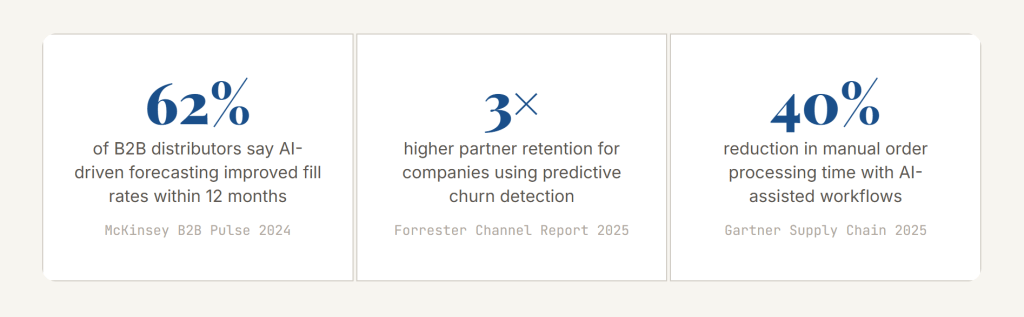
Today’s channel environment is faster, more fragmented, and more competitive than ever. Contractors and dealers have more options. Margins are thinner. Customer expectations — shaped by consumer-grade digital experiences — have migrated into B2B. Distributors who still rely purely on gut feel and rep relationships are starting to feel the gap.
AI is not arriving to replace the relationship. It is arriving to rescue the rep from everything that gets in the way of it.
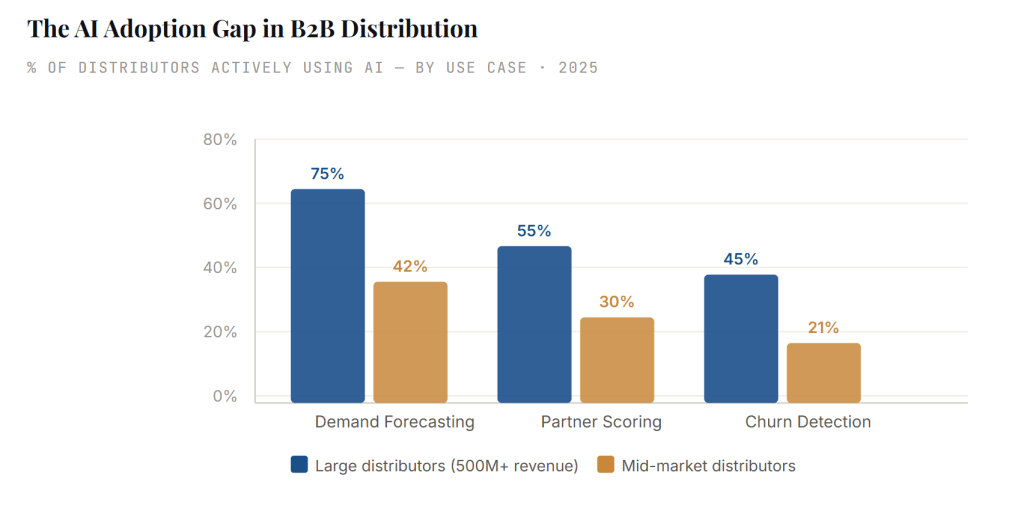
The AI Evolution in Channel Distribution
FROM REACTIVE → PREDICTIVE → PRESCRIPTIVE
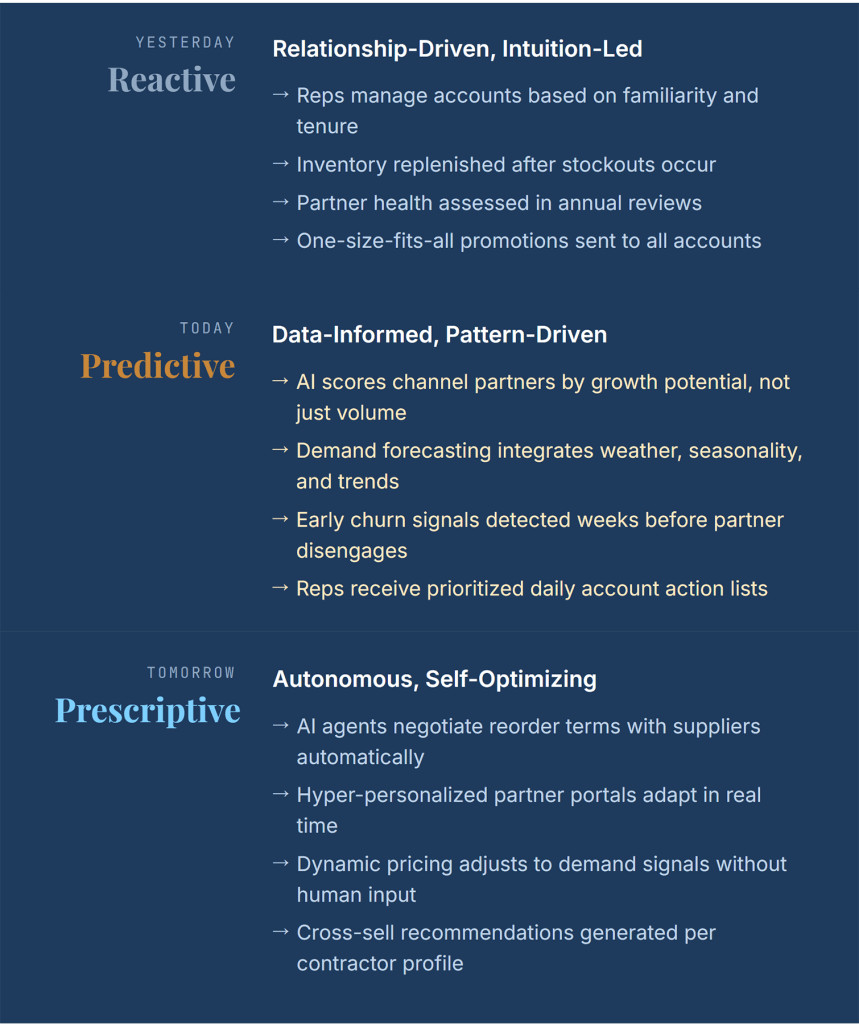
From Gut Feel to Data-Driven Channel Decisions
Ask any experienced channel manager how they prioritize accounts, and the honest answer is usually: the ones I know best, the ones who call the most, the ones who have been around the longest. That instinct is valuable — but it is also biased toward visibility rather than potential.
AI analyzes patterns across thousands of transactions that no human can hold in their head simultaneously: which partners are quietly growing their basket size, which accounts show early signs of defection, which product categories are underleveraged in specific regions.
Real Example
Wesco International — Electrical Distribution
Schneider Electric, managing thousands of certified electrical distributors and contractors globally, implemented a partner health scoring model as part of its mySchneider partner portal. The AI flagged accounts showing a defined pattern of disengagement — declining training participation, reduced product registration activity, and order cadence dips — and routed alerts to regional channel managers with recommended intervention scripts.
Critically, the system prioritized alerts by estimated revenue at risk, helping regional managers decide which accounts warranted a phone call versus a targeted email re-engagement sequence. The human relationship was preserved — AI simply made sure it happened at the right moment.
↑ 28% partner retention improvement
Early intervention on 40% of at-risk accounts
↓ Cost of partner replacement
Key Insight“The best channel managers are not being replaced by AI — they are being amplified by it. Their judgment becomes sharper when informed by data they could never have assembled manually.”
Predictive Demand Replaces Reactive Replenishment
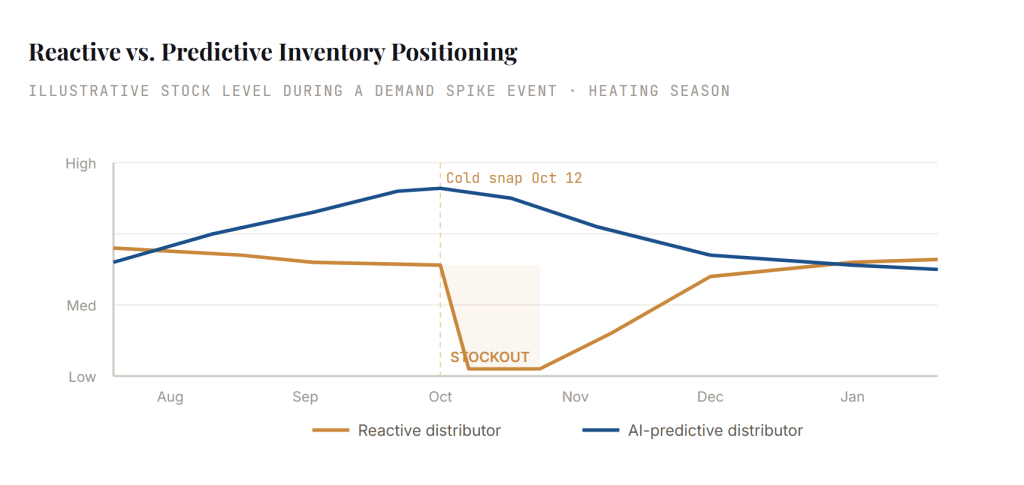
In seasonal product categories — electric heating being a prime example — timing is everything. A cold snap in October can trigger a wave of contractor orders within days. Distributors who saw it coming and pre-positioned inventory capture the sale. Those still waiting for purchase orders are left scrambling.
Traditional replenishment is reactive by design: you reorder when stock drops. AI-powered forecasting inverts this logic entirely by integrating weather patterns, historical sales cycles, regional construction activity, and partner order behavior to anticipate demand before it materializes.
Real Example
Rexel Group — Global Electrical Distribution
Rexel, operating across 26 countries with deep exposure to HVAC and electrical product distribution, implemented AI demand forecasting at its European distribution centers. The model incorporated regional weather APIs, contractor project pipelines sourced from permit data, and historical order seasonality to predict demand 6–8 weeks out.
In France and Germany — markets with harsh heating seasons — the system consistently pre-positioned inventory before competitor distributors. Contractors who found product available during peak demand periods shifted a greater share of wallet to Rexel without the commercial team ever asking for it.
↑ 22% fill rate improvement
↓ 35% emergency freight costs
↑ Contractor share-of-wallet
Key Insight“In seasonal distribution, the company that forecasts best wins — not the one with the biggest warehouse.”
Personalized Engagement — at Scale
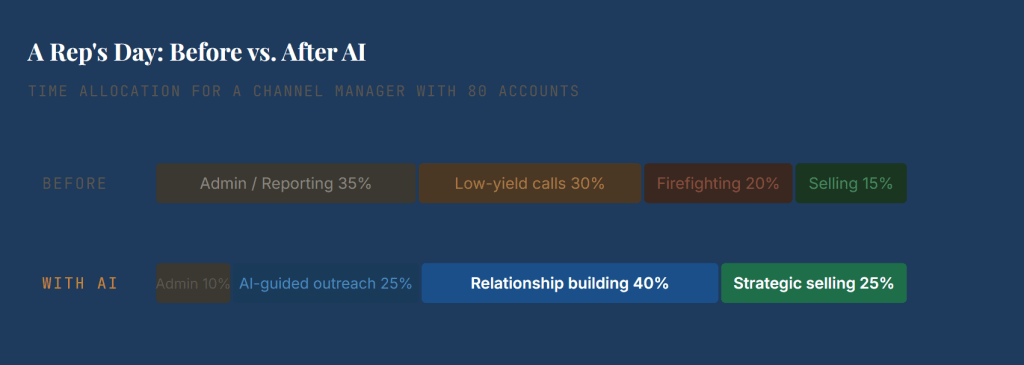
One of the structural tensions in channel sales has always been scale versus intimacy. A rep managing 80 accounts cannot give each one the attention it deserves. Inevitably, the top 15 get most of the time, and the rest get periodic check-ins and generic communications.
AI breaks this trade-off. With the right tools, a commercial team can deliver tailored recommendations, timely promotions, and contextually relevant outreach to hundreds of accounts simultaneously — each message informed by that partner’s actual buying history, seasonal patterns, and product mix.
Real Example
Grainger — Industrial B2B Distribution
Grainger, serving over 4.5 million B2B customers across North America, deployed an AI recommendation engine across its digital channel. Rather than surfacing generic “best sellers,” the system analyzed each customer’s purchase history, industry vertical, and seasonal usage patterns to generate hyper-personalized product recommendations at every touchpoint — email, website, and rep-assisted calls.
For channel partners specifically, the engine identified cross-sell opportunities based on what comparable businesses in the same vertical were buying — a technique borrowed from consumer e-commerce applied with precision to industrial distribution.
↑ 15% cross-sell conversion rate
↑ Average order value per partner
↓ Irrelevant outreach complaints
Key Insight“Scale used to mean standardization. AI makes scale feel personal — and partners who feel known stay longer.”
The Early Warning System You Never Had
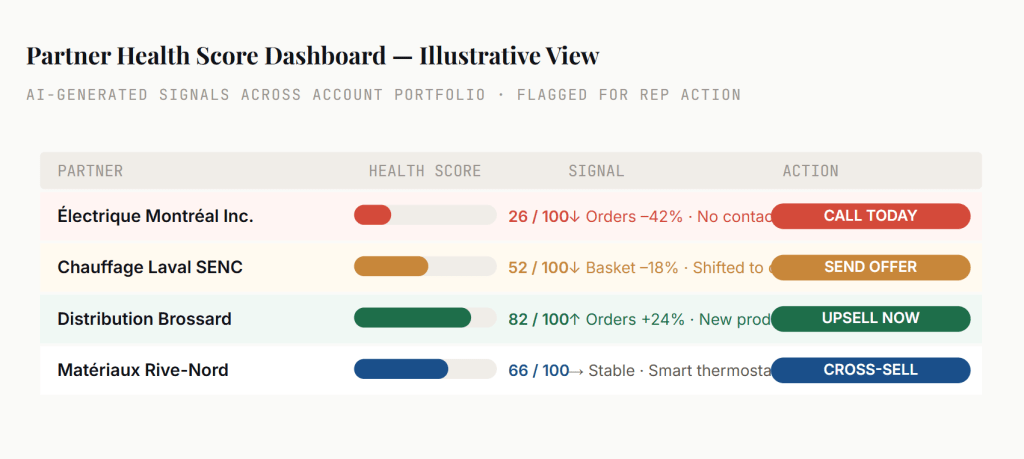
Losing a channel partner rarely happens overnight. It happens gradually — a slightly smaller order here, a longer gap between purchases there, a quiet shift toward a competing brand. By the time the relationship ends, the signals were present for months.
AI gives commercial teams something they have never had before: an early warning system for partner disengagement. By monitoring behavioral signals — order frequency, basket composition, responsiveness to outreach, product mix evolution — AI can flag accounts that are quietly drifting before the relationship is lost.
Real Example
Schneider Electric — Partner Network Management
Schneider Electric, managing thousands of certified electrical distributors and contractors globally, implemented a partner health scoring model as part of its mySchneider partner portal. The AI flagged accounts showing a defined pattern of disengagement — declining training participation, reduced product registration activity, and order cadence dips — and routed alerts to regional channel managers with recommended intervention scripts.
Critically, the system prioritized alerts by estimated revenue at risk, helping regional managers decide which accounts warranted a phone call versus a targeted email re-engagement sequence. The human relationship was preserved — AI simply made sure it happened at the right moment.
↑ 28% partner retention improvement
Early intervention on 40% of at-risk accounts
↓ Cost of partner replacement
Key Insight“Losing a channel partner rarely happens overnight. AI sees it coming months in advance — and gives you the time to act.”
The Trust Paradox
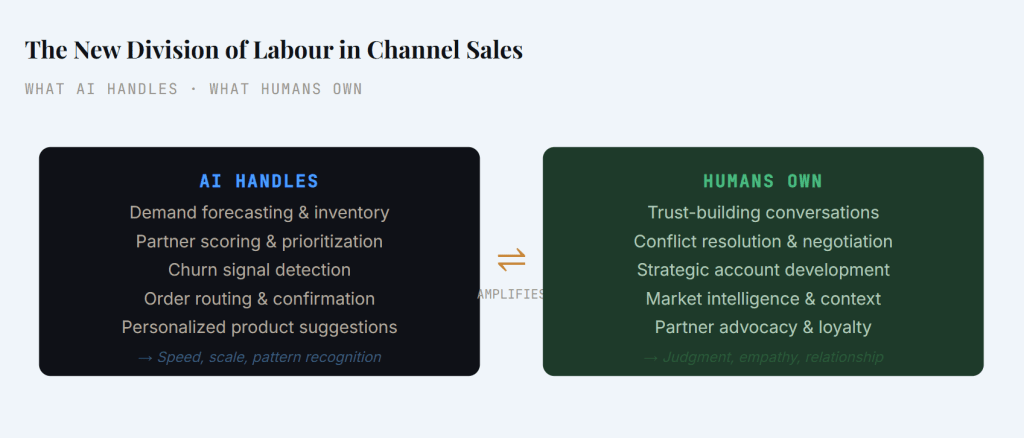
Here is the counterintuitive truth at the center of all of this: the more AI automates channel interactions, the more the human relationship becomes a competitive differentiator.
When transactional friction is removed — ordering is seamless, forecasting is accurate, communication is timely — what differentiates one distributor from another is no longer operational. It becomes relational. The quality of the conversation. The speed of problem resolution. The sense that someone actually understands your business.
AI does not eliminate the need for trust in channel sales. It raises the stakes for it.
Real Example
Johnstone Supply — HVAC Distributor Network
Johnstone Supply, a leading North American HVAC distributor operating through a franchise model, faced a classic channel tension: automation of ordering and inventory was reducing counter traffic, which had historically been the primary vehicle for relationship-building with HVAC contractors.
Rather than resist automation, Johnstone doubled down on AI for the transactional — building a contractor-facing app with AI-powered product lookup, availability, and ordering — and reinvested the time saved at the counter into technical training, product knowledge events, and field visits. The result was a deeper, more consultative relationship precisely because the routine friction was gone.
↑ Contractor NPS score
↑ Training session attendance
Stronger counter rep relationships
Key Insight“The distributors who will win the next decade are not the ones who automate the most — they are the ones who use AI to handle the transactional, and free their best people to do what only humans can.”
Synthesized from 5 real cases
Lessons Learned from Early AI Adopters in Distribution
| 1 | Data quality is the real barrier — not technology Every company that succeeded started by cleaning and structuring its existing transaction data before touching any AI tool. Wesco and Grainger both cite internal data governance as the unglamorous prerequisite that made everything else work. Garbage in, garbage out is not a cliché — it is the most common reason AI pilots fail in distribution. |
| 2 | Rep adoption is make-or-break Rexel and Schneider Electric both learned that AI tools deployed without rep buy-in collect dust. The most successful rollouts treated frontline reps as co-designers — showing them how the system’s outputs made their own targets easier to hit, not threatening their judgment. Positioning AI as a “better briefing” rather than a “performance tracker” was the difference. |
| 3 | Start narrow, prove value, then expand None of these companies deployed AI across all use cases simultaneously. Rexel began with a single product category in two countries. Schneider Electric piloted partner health scoring in one region before rolling out globally. The pattern is consistent: a small, visible win builds internal credibility far faster than a sweeping transformation roadmap. |
| 4 | The biggest ROI often comes from retention, not acquisition Across all five cases, the sharpest return on AI investment came not from acquiring new channel partners — but from retaining existing ones longer and growing share of wallet. Replacing a distributor partner typically costs 5–7x more than keeping one. Early warning systems that prevent churn generate returns that are large in magnitude but invisible in standard revenue reporting. |
| 5 | AI surfaces the conversation — it does not replace it Johnstone Supply’s experience is the clearest illustration: automation freed counter reps to have better conversations, not fewer. The companies that treated AI as a replacement for human interaction saw engagement decline. Those that used it to identify the right moment for a human touchpoint saw relationships deepen. The tool’s job is to tell the rep when to pick up the phone — not to make the call for them. |
What This Means for Commercial Leaders in Distribution
If you lead a commercial function in distribution today, the question is no longer whether AI will reshape your channel relationships. It already is — at your competitors, if not yet at your company.
Start with the data you already have. Most distributors sit on years of transaction history that has never been analyzed at scale. That data is the foundation of everything else.
Start with one use case that solves a real problem. Demand forecasting, partner scoring, early churn detection — pick the one that addresses your most acute pain point and build credibility from there.
And start with your people. A forecast no one trusts is useless. A churn alert no one acts on changes nothing. AI works best when the teams using it understand what it is doing — and why.
To continue the conversation
The Questions Worth Sitting With
- As AI makes it easier to identify which channel partners are underperforming, what obligation does a distributor have to invest in developing them — versus simply reallocating resources to higher-potential accounts?
- When AI flags a partner as “at risk of churning,” should that trigger a commercial intervention or a genuine conversation about whether the relationship still makes sense for both sides?
- If AI enables a distributor to engage with 10x more accounts at a personalized level, does scale of reach eventually dilute the authenticity that made the channel relationship valuable in the first place?
- As demand forecasting becomes more sophisticated, how do distributors avoid creating a two-tier market — where AI-enabled partners get better availability and service, while smaller, less digitized contractors fall further behind?
- When AI optimizes for measurable signals like order frequency and basket size, are we at risk of building channel strategies that ignore the qualitative dimensions of partnership — trust, resilience, shared risk — that only reveal their value in a crisis?
These are not rhetorical questions. They are the ones that will define what kind of distributor you choose to become — not just how efficiently you distribute.
Sources & Further Reading
The State of AI in B2B Sales — McKinsey & Company
McKinsey Global Institute · B2B Pulse Survey 2024
mckinsey.com/capabilities/growth-marketing-and-sales/our-insights/ai-in-b2b-sales
Channel Partner Retention in the Age of Predictive Analytics
Forrester Research · Channel Program Report 2025
forrester.com/report/channel-partner-ai-retention-2025
AI-Augmented Supply Chain: Demand Sensing and Distributor Networks
Gartner Supply Chain Research · 2025
gartner.com/en/supply-chain/insights/ai-demand-sensing-distribution
Wesco International Annual Report — Digital Transformation Section
Wesco International Inc. · SEC Filing 2024
wesco.com/en-US/about/investor-relations/annual-reports.html
Rexel Group — Digital Strategy & AI Initiatives
Rexel Group Investor Presentation · Paris, 2024
rexel.com/en/group/investors/financial-documents
Grainger 2024 Analyst Day — AI and Personalization Strategy
W.W. Grainger Inc. · Investor Relations 2024
investor.grainger.com/events-and-presentations
mySchneider Partner Program — AI-Enabled Partner Lifecycle Management
Schneider Electric · Partner Portal Documentation 2024
se.com/ww/en/partners/myschneider
The Future of B2B Distribution: Digital Transformation Benchmarks
Deloitte Insights · Industrial Distribution Study 2025
deloitte.com/us/en/insights/industry/industrial-manufacturing/b2b-distribution-digital.html
Predictive Analytics in HVAC Distribution — Contractor Loyalty Drivers
HARDI (Heating, Air-Conditioning & Refrigeration Distributors International) · 2024 Annual Report
hardinet.org/research-analytics
AI Adoption in Mid-Market Distribution: Barriers and Accelerators
NAW (National Association of Wholesaler-Distributors) · Digital Research Series 2025
naw.org/research/digital-transformation-series