Protecting Domestic Wire and Cable Manufacturing: The Case for a ‘Northern Pledge’
June 23, 2026
By Jeffrey Moyle, CEO, Rexel Canada Electrical Inc.
The electrical distribution industry in Canada and across North America stands at a pivotal moment. For decades, reliance on global supply networks has often delivered short-term efficiency, but it has also exposed structural vulnerabilities that can no longer be overlooked. Recent disruptions — from the pandemic to geopolitical instability to persistent lead-time volatility — have highlighted how fragile extended supply chains can become when critical products are sourced far from the markets they serve.
While every industry has experienced some form of disruption, the Canadian wire and cable sector has faced particularly acute pressure, and it is this dynamic that forms the focus of the observations that follow.
‘Support’ takes many forms, but the most meaningful is demonstrated through action — specifically, by increasing the share of North American-made products within our own networks. This approach reflects our belief that domestic manufacturing matters, that regional supply chains deserve continued investment, and that we are committed to supporting the partners who continue to strengthen this industry.
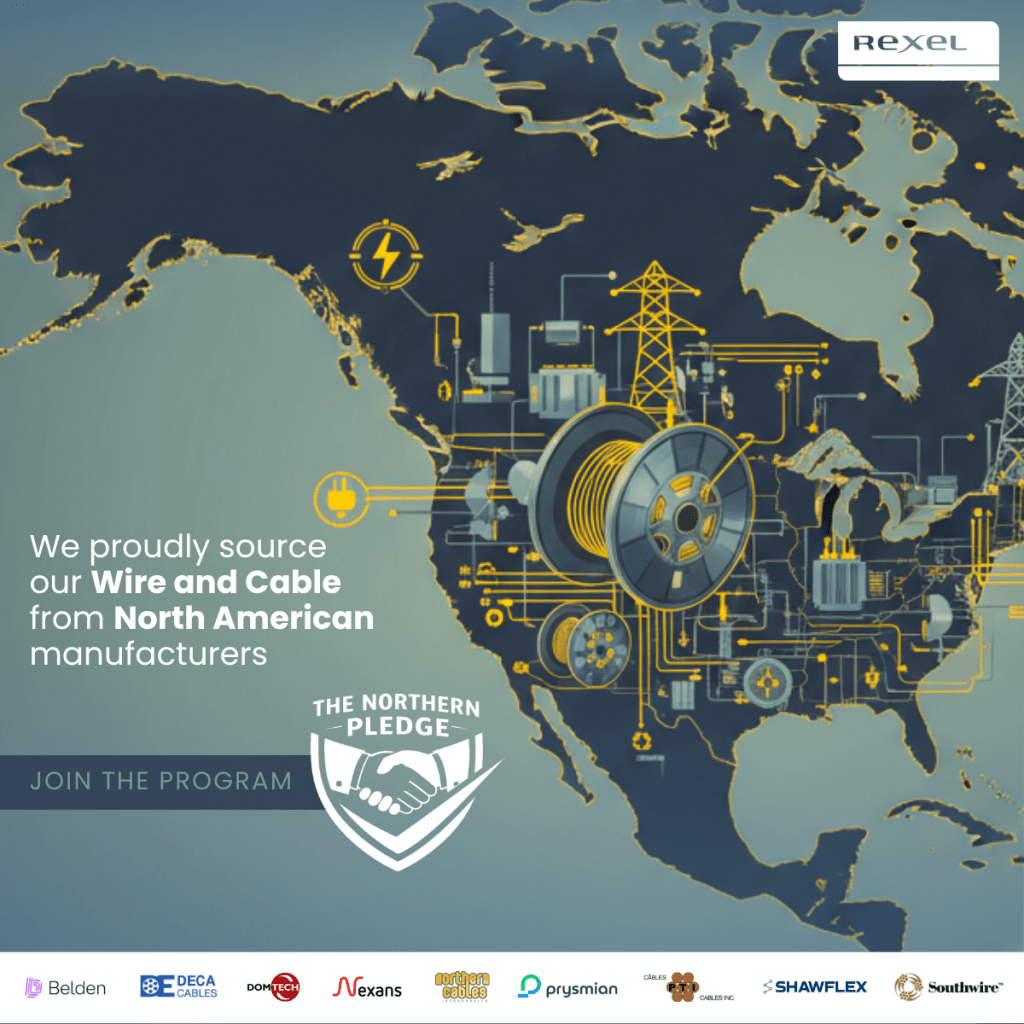
That is precisely what the Northern Pledge is intended to support. What began internally within our company as a placeholder for domestic sourcing has evolved into something of greater significance: a public commitment to stand behind North American manufacturers and help advance a stronger, more resilient regional supply chain. Whether through purchasing decisions, customer engagement, or simply affirming support for those leading the way, the pledge represents our approach to demonstrating where we stand. It is not a rigid program, but rather a commitment rooted in purpose and responsibility.
Rexel Canada is committed to sourcing the vast majority of its wire and cable from North American manufacturers. While no supply chain is perfect, we remain mindful of the risks and pressures that continue to affect our industry, and we believe regional resilience deserves serious attention. This is not just a messaging exercise. It is a deliberate business choice with real implications for quality, responsiveness, and long-term stability across the value chain.
Canada has a long history of making strategic choices in support of its economic and social development. From Sir John A. Macdonald’s National Policy, which helped foster emerging industries in the late 19th century, to the evolution of our social programs and public infrastructure, we have repeatedly recognized that national prosperity is strengthened when we invest in our own capacity. These historical examples remind us that domestic investment is not an abstract concept — it is a foundational element of national resilience.
Today, the case for domestic sourcing reflects that same logic. The longstanding view that “responsible offshoring” can always achieve the right balance between operational efficiency and supply chain stability has increasingly been challenged by events on the ground. The pandemic and its aftershocks, along with ongoing global disruptions, have made clear that critical manufacturing cannot be treated as if geography were irrelevant. In many cases, the assumption that offshore sourcing can be managed without trade-offs has proven overly optimistic.
At the same time, the wire and cable industry — with PTI leading the charge and the support of steadfast organizations like Northern Cables, who have championed this position for years — is already doing the substantial work required to advance domestic production and protect Canadian manufacturing capacity. It is important to acknowledge that several newer entrants to the industry have stepped forward to lead this effort, and they deserve significant credit for doing so. While many, myself included, had reservations about the effectiveness of this approach, they chose to act. Through the filing of trade complaints and the navigation of complex trade law, organizations such as PTI have taken meaningful steps to safeguard local producers and reinforce the industry’s underlying foundation.
This reflects an important reality: the transition toward a more resilient domestic base is being driven by a relatively small group of committed leaders on behalf of a much broader sector. Canada has often been slower than other jurisdictions to adopt protective measures, leaving too many manufacturers exposed to pressures from unfair trade practices. What is needed now is for each company to assess its own role in supporting a healthier domestic supply chain.
This discussion is not only economic in nature — it is strategic. Domestic sourcing and onshoring are increasingly central to the conversation about resilience. The Canadian government’s “Buy Canadian” procurement policy, with its emphasis on meaningful economic activity within Canada and, in certain cases, Canadian-produced materials, reflects a wider recognition that procurement can play an important role in strengthening local industry. Manufacturing already contributes significantly to Canada’s economy, supporting output, GDP, skilled employment, apprenticeships, and innovation. When we invest in local production, we are also investing in technical expertise, industrial capacity, and the communities that depend on them.
This is precisely where individual leadership becomes indispensable. Distributors, in particular, occupy a uniquely influential position in demonstrating confidence in North American-made solutions. Through engagement with manufacturers, contractors, utilities, and end-users, distributors can help reinforce the resilience and competitiveness of the broader industrial ecosystem while also advancing the long-term vitality of their own enterprises. In this context, local sourcing should be understood as more than a supply chain decision — it is an investment in the future strength, stability, and sustainability of the industry.
The path forward should be guided not by slogans, but by practical decisions, open dialogue, and a clear sense of purpose. We can continue to depend on global systems that work well until they don’t, or we can make deliberate investments in a more resilient, locally anchored future. At Rexel Canada, the choices we are making today are intended to strengthen our manufacturing partnerships, the reliability of our supply chains, and the foundation we leave for the future.
The distribution sector has an important role to play. By making thoughtful purchasing decisions and engaging with policy priorities that support a stronger domestic manufacturing base, individual companies can contribute to outcomes that benefit their businesses while also strengthening the communities and economies that depend on them. At Rexel, we see this as a strategic priority. We believe in leading by example, and in doing so, shaping our own future.
For more information, visit Rexel Canada HERE.