Investment in Building Construction, April 2026
July 15, 2026
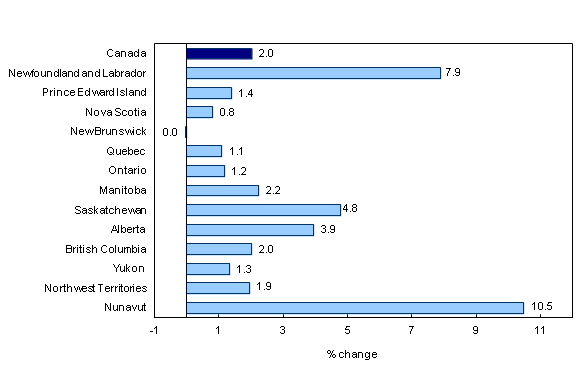
The total value of investment in building construction increased $540.8 million (+2.3%) to $23.6 billion in April. The residential sector rose 3.1%, while the non-residential sector edged up 0.7%. Year over year, investment in building construction grew 7.8% in April.
On a constant dollar basis (2023=100), the total value of investment in building construction in April increased 2.2% from the previous month to $21.5 billion, and it was up 4.5% year over year.
Chart 1
Investment in building construction, seasonally adjusted

Multi-unit component drives growth in residential investment
In April, investment in residential building construction increased $491.9 million to $16.5 billion. Both the multi-unit component (+4.0%) and the single-family component (+2.0%) contributed to the increase.
Investment in multi-unit construction investment was up $338.8 million to $8.8 billion in April. British Columbia (+$231.2 million) led the increase, and it was supported by broad gains across four other provinces and two territories.
Meanwhile, investment in single-family home construction rose $153.1 million to $7.7 billion in April. Growth in Quebec (+$136.0 million) and Ontario (+$83.8 million) was moderated by broad declines across seven provinces and one territory, led by British Columbia (-$23.1 million).
Infographic 1
Investment in residential building construction, April 2026

Chart 2
Investment in residential building construction, seasonally adjusted

Non-residential building investment edges up
In April, the value of non-residential investment in building construction edged up $49.0 million to $7.1 billion. Increases in the industrial (+3.5%) and commercial (+0.1%) components were moderated by a slight decline in the institutional component (-0.2%).
Investment in the industrial component grew $48.8 million to $1.4 billion in April. Ontario (+$25.8 million), British Columbia (+$16.4 million) and Alberta (+$5.2 million) were the primary contributors to the increase. In total, six provinces and two territories contributed to the growth in this component.
Investment in commercial construction edged up $4.1 million to $3.5 billion in April, led by Alberta (+$10.0 million) and British Columbia (+$3.6 million). The gains in these two provinces were partially offset by declines in Ontario (-$7.9 million) and Quebec (-$1.3 million).
Meanwhile, investment in the institutional component edged down $3.9 million to $2.2 billion in April. Declines in Quebec (-$5.8 million), Manitoba (-$1.6 million) and Nova Scotia (-$1.6 million) were tempered by an increase in Ontario (+$5.3 million).
Infographic 2
Investment in non-residential building construction, April 2026