The Role of Offshore Sourcing: An Editorial Perspective for Manufacturers, Distributors, Agents, Contractors, and Industry Stakeholders
June 3, 2026
By: Kerrwil Editorial Team
Offshore sourcing is often cast as the villain in the Canadian electrical market: cheaper products, suspect quality, and a trail of risk that ends at the job site. But that story is incomplete. When done right, offshore manufacturing has strengthened the electrical channel, not weakened it.
The real divide is not domestic versus offshore. It is between committed, accountable partners and transactional, price‑only players. The CSA mark sits inside that story as one important signal but it is only a subset of what the market should be looking at.
For decades, many manufacturers have sourced offshore while staying firmly committed to the Canadian electrical channel. They use global manufacturing to stay competitive, but they invest in the people, inventory, technical support, and programs that make them real, long‑term players in Canada. They join and support national and regional associations, contribute to standards and research, and show up for the conversations that shape the Canadian industry’s future.
These suppliers understand that while production may be global, trust is local. They treat the channel not as a cost to be bypassed, but as an ecosystem of accountability: distributors who vet and stock product, agents who create demand and provide insight, and contractors who stand behind installations for years. Offshore sourcing, in their hands, is one element of a broader strategy built on commitment, not a shortcut around it.
Within this larger picture, the CSA mark and other recognized approvals play a critical but limited role. In Canada, you cannot legally sell or install electrical equipment without a recognized approval. A mark tells regulators and inspectors that a sample of the product met the applicable safety standard. It is a necessary gatekeeper.
However, that is where its job largely ends. The mark does not tell contractors and distributors:
- Whether the product is under a full certification program with recurring factory inspections, or a one‑time/limited evaluation.
- Whether the manufacturer has maintained consistency in materials and construction after the original test.
- Whether there is a real, accountable organization in Canada that will stand behind the product over its life.
When every approved product on the shelf carries essentially the same symbol, it is easy for the market to treat that symbol as the whole story. In reality, the mark is only one of the inputs into a bigger judgment about supplier behavior, sourcing strategy, and long‑term commitment.
If the CSA mark becomes the primary or only decision point once minimum legality is satisfied, several distortions creep in.
First, disciplined manufacturers domestic and offshore who operate under full certification programs and recurring audits pay for robust quality systems, have in house staff monitoring this, they have conservative designs, and ongoing compliance. Their costs reflect the reality of building and maintaining product that consistently matches the tested design.
Second, suppliers who treat certification as a checkbox may do something very different. They may certify a representative sample, then quietly reduce material thickness, change plastics, or alter conductor sizes in production while continuing to apply the same mark. They may use certification models with minimal or no factory surveillance. On paper and on the nameplate, the product looks equivalent. Inside the box, it may not be.
Third, when the market treats the mark as the great equalizer, the decision collapses to price. The product that carries the real cost of compliance sits next to a product that has shaved cost out of construction and oversight, and both are presented as “approved.” The lowest price wins the day, and the differences that matter most durability, safety margin, support are invisible at the moment of purchase.
Finally, when failures happen, the risk flows downstream. The paper trail often leads back to contractors and distributors who “should have known better,” even though in practice they had little visibility into how the product was actually built. The CSA mark remains, but the liability does not stop at the lab.
None of this is an argument against certification. It is an argument against letting the mark carry a job it was never designed to do: stand in for full due diligence on sourcing and business model.
This is where offshore sourcing and the CSA mark intersect in a meaningful way.
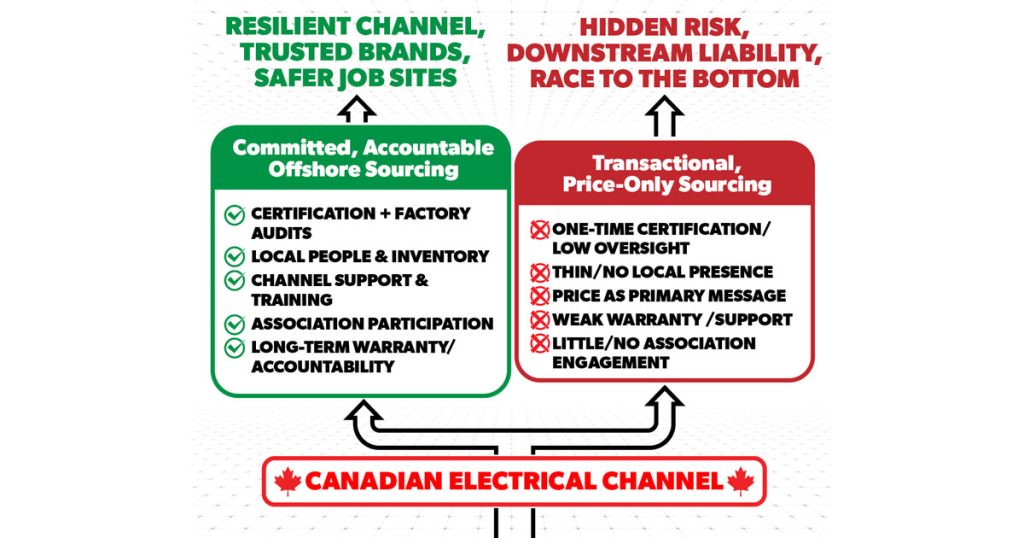
On one side are the committed offshore suppliers:
- They secure and actively maintain proper certifications for Canadian use, with ongoing factory surveillance.
- They invest in local presence people, warehouses, technical support, after‑sales service.
- They work through the electrical distribution channel, recognizing its role in vetting products and supporting contractors.
- They participate in industry associations and initiatives, aligning with shared goals on safety, standards, and training.
- They invest in demand creation and brand defense advertising, education, and preference building so the channel is not left selling on price alone.
- They plan to be here long enough to honour warranties, support investigations, and stand behind their products when things go wrong.
Most of these companies use offshore manufacturing. That is not a shortcut; it is simply how they stay cost‑competitive while still paying for compliance, quality, and channel support.
On the other side are transactional, price‑only models:
- Product is dropped into the market with little transparency about origin or factory discipline.
- Certification may exist but is poorly understood, minimally maintained, or not matched by consistent manufacturing process.
- Local presence is thin or non‑existent; practical warranty support is limited.
- There is no meaningful engagement with associations, standards work, or training.
- The only “marketing” is a discount; there is no investment in building brand, education, or trust.
Both models often use offshore sourcing. Both may carry a CSA mark. The difference is everything wrapped around the product: how sourcing is managed, how certification is maintained, how the channel is supported, how seriously the supplier accepts long‑term accountability and how they stand behind their brand.
For distributors, private‑label programs and direct imports can be powerful tools. They offer margin, differentiation, and strategic leverage. But they also shift responsibility. When your name is on the box, the contractor’s trust moves from a global brand to your brand. In that scenario, the CSA mark is necessary, but it is only one piece. The distributor’s own standards for factory selection, ongoing oversight, inventory support, training, and warranty handling become part of the value proposition.
For contractors, the answer is not “avoid offshore.” The answer is “differentiate between offshore products backed by committed, visible partners and those that are purely transactional.” That means some due diligence has to happen:
- Asking whether the product is under a full certification program with recurring inspections.
- Paying attention to construction quality weight, materials, fit, and finish as clues to how aggressively costs have been cut.
- Preferring brands and distributors that show up with training, documentation, and clear lines of accountability in Canada.
- Documenting decisions on major projects when you choose products based on quality, support, and track record, not just the lowest unit price.
In both cases, the mark is your starting gate. The real decision is about the model behind it.
The Canadian electrical industry is in flux: consolidation among distributors and agents, new sourcing models, more private label, and the rise of digital platforms that make price comparisons effortless. In that context, the principles we choose to reward now will shape the channel that emerges.
If the industry continues to let price and a bare minimum approval mark drive the conversation, it will keep incentivizing transactional, low‑commitment models many of them offshore, some of them domestic. The “cheap reel that costs more later” will remain the recurring cautionary tale.
If, instead, the industry actively rewards the right kind of offshore sourcing where certification is real, accountability is local, the channel is respected, and brand and education are invested in offshore manufacturing becomes a strength. It allows suppliers to compete globally on cost while maintaining high standards of safety, reliability, and support at home.
The choice in front of the Canadian electrical industry is not simply “domestic versus offshore.” It is “transactional versus committed.” The CSA mark is an essential part of that conversation, but it is only a subset. The real test is whether a supplier wherever they build invests in quality, in people, in brand, and in the channel. That is how offshore sourcing strengthens, rather than weakens, the electrical channel.