Gross Domestic Product by Industry, August 2026
November 4, 2026
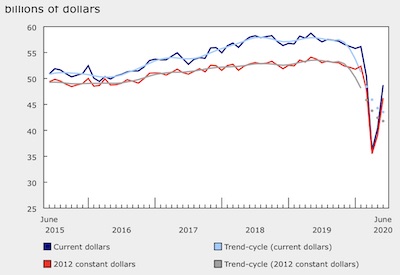
Real gross domestic product (GDP) was essentially unchanged in August. Of the 20 industrial sectors, 9 expanded. This was the second consecutive month where real GDP was essentially unchanged.
Chart 1
Real gross domestic product is essentially unchanged in August

The services-producing industries aggregate edged down 0.1% in August, as decreases in the wholesale trade and public administration sectors were partially offset by increases in retail trade. The goods-producing industries grouping edged up 0.1%, as expansions in manufacturing and construction more than offset the decline in utilities.
Retail trade rebounds in August on widespread strengths across most subsectors
The retail trade sector rose 1.2% in August, more than offsetting the contraction in July, as most subsectors expanded.
Chart 2
Retail trade sector increases in August

A rebound in motor vehicle and parts dealers (+1.8%) led the increase in August, driven by higher sales at new car dealers and more than offsetting the decline in July. Food and beverage retailers (+1.3%) also rebounded in August on widespread increases across all store types and more than offset the back-to-back monthly declines in June and July. Rebounds in general merchandise retailers (+1.5%) and health and personal care retailers (+1.3%) further contributed to the increase in August.
Lower activity at gasoline stations and fuel vendors (-0.6%) tempered growth in the sector in August.
The manufacturing sector continues to grow
The manufacturing sector rose 0.3% in August, up for the fifth time in seven months.
Machinery manufacturing was up 3.8% in August, coinciding with higher exports of machinery and equipment.
Petroleum refineries rose 4.2% in August, marking its first increase in four months as some refineries resumed production following the completion of unscheduled maintenance in July. Increased activity in the industry in August coincided with a sharp increase in exports of refined petroleum energy products.
Transportation equipment manufacturing decreased 3.1% in August, driven by a 5.8% contraction in motor vehicles and parts manufacturing, as a prolonged summer shutdown at a major auto assembly plant dampened activity in the industry.
Rail transportation drives the growth in transportation and warehousing
Rail transportation grew 3.6% in August, the largest monthly growth rate since March 2025. Movements of wheat by rail contributed the most to the increase in August 2026 following a record high wheat production for the crop year. Additionally, intermodal shipments and the freight traffic arriving from the United States further contributed to the growth.
Air transportation increased by 1.3% in August, rising for the fourth consecutive month, coinciding with Canadian air carriers adding new seasonal routes to destinations outside the United States over the summer.
The finance and insurance sector expands on broad-based growth
Finance and insurance rose 0.2% in August, on broad-based expansions across all subsectors. A rebound in banking, monetary authorities and other depository credit intermediation (+0.3%) led the expansion, reflecting increases in non-mortgage loan activity, specifically credit card activity at chartered banks. Other finance and insurance activity (+0.2%) also expanded in August, driven by higher mutual funds activity and coinciding with increased gold purchases, as investors hedged against policy risks, trade uncertainties and geopolitical tensions.
Wholesale trade is the largest detractor to growth
Wholesale trade declined 1.4% in August on widespread contractions across most subsectors.
Chart 3
Wholesale trade sector contracts in August

Motor vehicle and motor vehicle parts and accessories wholesalers (-4.4%) contracted in August for the first time in seven months. The contraction of this subsector coincided with lower imports of passenger cars and light trucks as well as weaker than usual motor vehicle manufacturing activity in August.
Building material and supplies wholesalers (+0.5%) tempered the decline in August, rising on strengths in the lumber, millwork, hardware and other building supplies industry group. This was the third consecutive monthly increase for building material and supplies wholesalers.
Widespread contractions in public administration weigh on the public sector
The public sector aggregate (comprising educational services, health care and social assistance, and public administration) fell 0.2% in August, marking its first decline in six months.
Federal government public administration (except defence) (-2.1%) contributed the most to the decline in August, as 2026 Census work continued to wind down.
Mining, quarrying, and oil and gas extraction stalls in August
The mining, quarrying and oil and gas extraction sector was essentially unchanged in August.
Mining and quarrying (except oil and gas) (+4.9%) posted the largest monthly growth rate since July 2025, as some industries that were experiencing production disruptions rebounded in August 2026. Potash mining expanded 12.0% in the month following a 7.8% decline in July and coincided with higher exports of the product in August. Other metal ore mining (+56.2%) fully offset its July decline as extraction and ores processing in northern Saskatchewan resumed following production disruptions.
Oil and gas extraction decreased 1.2% in August, down for the third consecutive month. Oil sands extraction contributed the most to the decline with a 2.1% contraction, as some mining facilities in northern Alberta underwent maintenance activities.
Utilities down in August as some nuclear power plants undergo maintenance outages
The utilities sector fell 0.4% in August, driven by a 0.5% contraction in electric power generation, transmission and distribution. Nuclear power generating stations in Ontario and New Brunswick underwent maintenance outages in August, which contributed to a decline in nuclear electricity generation in both provinces in the month. Meanwhile, natural gas distribution expanded 0.6% as natural gas deliveries to industrial users rose in August.
Chart 4
Main industrial sectors’ contribution to the percent change in gross domestic product in August

Advance estimate for real gross domestic product by industry for September 2026
Advance information indicates that real GDP decreased 0.1% in September. Decreases in manufacturing and mining, quarrying and oil and gas extraction were partially offset by increases in utilities and wholesale trade. Owing to its preliminary nature, this estimate will be updated on November 30, 2026, with the release of the official GDP by industry data for September.
With this advance estimate for September, information on real GDP by industry suggests that the economy expanded 0.3% in the third quarter of 2026. The official estimate for the third quarter will be available on November 30, 2026, when the official estimate of real GDP by income and expenditure is released.