February Wholesale Sales Decline 2.2%
May 2 2016
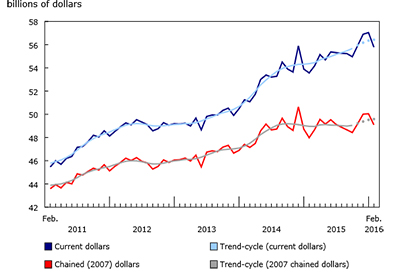
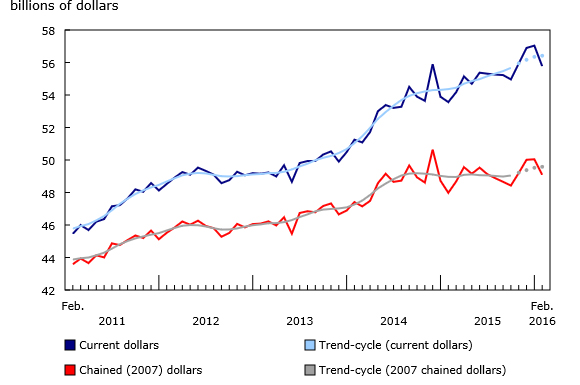
Wholesale sales decreased 2.2% to $55.8 billion in February after three consecutive increases. Lower sales were recorded in five of seven subsectors, accounting for 66% of total wholesale sales.
In volume terms, wholesale sales declined 1.9%.
Lower sales in five subsectors
The machinery, equipment and supplies subsector recorded the largest decline in dollar terms in February, decreasing 4.8% to $11.0 billion and more than offsetting the 4.1% gain in January. Every industry within the subsector recorded lower sales, led by the construction, forestry, mining, and industrial machinery, equipment and supplies industry (-11.5%). Decreases in exports and imports of industrial machinery, equipment and parts, and manufacturing sales of machinery were also recorded in February.
In the motor vehicle and parts subsector, sales decreased 3.5% to $10.4 billion, their lowest level in three months. All three industries in the subsector declined, led by the motor vehicle industry, down 3.6% to $8.0 billion, a second consecutive decrease. In February, there were lower imports and exports of motor vehicles and parts as well as lower sales by motor vehicle assembly plants.
Following a 2.5% increase in January, sales in the miscellaneous subsector declined 4.0% to $7.1 billion. The other miscellaneous industry (-7.7%) and the agricultural supplies industry (-6.1%) contributed to the decline.
In the building material and supplies subsector, sales decreased 1.8% to $7.6 billion, their lowest level since October 2015. The electrical, plumbing, heating and air-conditioning equipment and supplies industry contributed the most to the decline, decreasing 4.8% to $2.3 billion in February.
The personal and household goods subsector rose 1.4% to $7.9 billion on the strength of gains in the pharmaceuticals and pharmacy supplies industry (+2.9%), following two months of declines for the industry.
Sales decline in all but one province
Lower sales were recorded in nine provinces in February, led by Ontario and Saskatchewan.
In Ontario, sales declined for a second consecutive month, down 1.2% to $28.6 billion. The motor vehicle and parts subsector and the machinery, equipment and supplies subsector contributed the most to the decrease.
Sales in Saskatchewan fell 12.8% to $2.1 billion, their lowest level since August 2014. Declines were widespread across subsectors in this province, with the miscellaneous subsector being the largest contributor.
In Alberta, sales decreased 3.4% to $6.2 billion on widespread declines across subsectors. This second consecutive monthly decline brought sales in the province to their lowest level since September 2011.
Sales in Quebec decreased 1.6% to $10.1 billion, following six months of increases. Declines were recorded in a majority of the subsectors, with the miscellaneous subsector contributing the most to the decline.
Following a 3.9% gain in January, sales in British Columbia decreased 2.6% to $5.5 billion. The building material and supplies subsector led the decline.
Sales in Manitoba decreased 3.8% to $1.4 billion as the miscellaneous subsector and the motor vehicle and parts subsector led the declines.
Sales in the motor vehicle and parts subsector contributed the most to the decline in Nova Scotia, down 1.1% to $811 million.
Newfoundland and Labrador was the only province with higher sales in February. Following three consecutive declines, sales in this province were up 1.7% to $349 million, on the strength of higher sales in the food, beverage and tobacco subsector.
Inventories increase in February
Inventories rose 0.2% to $73.2 billion in February. Gains were recorded in three of seven subsectors, which together represented 61% of wholesale inventories.
Chart 2: Wholesale inventories increase in February
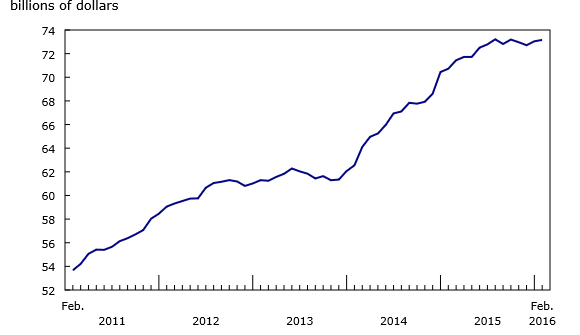
In dollar terms, the largest gain was in the machinery, equipment and supplies subsector (+0.8%), its second consecutive increase.
The personal and household goods subsector (+0.2%) recorded a third consecutive gain, while the motor vehicle and parts subsector (+0.2%) increased for the first time in three months.
Inventories decreased 0.3% in the building material and supplies subsector, a second consecutive decline.
After reaching their highest levels on record in January, inventories declined in the food, beverage and tobacco subsector (-0.4%) and the miscellaneous subsector (-0.2%).
The inventory-to-sales ratio rose from 1.28 in January to 1.31 in February. This ratio is a measure of the time in months required to exhaust inventories if sales were to remain at their current level.
Source: Statistics Canada, www.statcan.gc.ca/daily-quotidien/160420/dq160420a-eng.htm.