Investment in New Housing Construction Grows 8.7% YOY in June
August 31 2016
The increase at the national level reflects higher investment in all dwelling types, except semi-detached houses, which recorded a year-over-year decline for the 14th consecutive month.
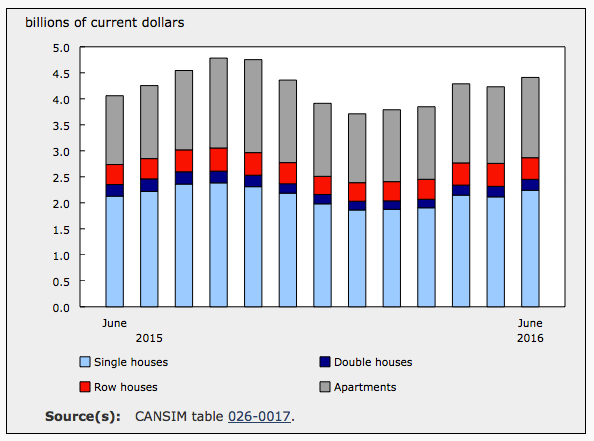
Spending on apartment and apartment-condominium building construction totalled $1.5 billion in June, up 16.7% from the same month a year earlier. Investment in single-family dwellings rose 5.3% from June 2015 to $2.2 billion, while spending on row house construction increased 8.1% to $416 million. Shown in chart: investment in new housing construction, by type of dwelling.
Provincially, construction spending rose in seven provinces. Ontario posted the largest advance, followed by British Columbia and Quebec.
In Ontario, investment in new residential building construction, which has been on an upward trend since the summer of 2014, grew 25.9% year over year to $1.8 billion in June. The increase resulted from higher investment in the construction of all dwelling types, with single-family dwelling construction, and apartment and apartment-condominium building construction accounting for much of the growth.
In June, British Columbia consolidated its place as the second largest provincial contributor of new housing construction investment. Spending in the province rose 33.0% compared with June 2015 to $950 million. The gain was led by higher investment in apartment and apartment-condominium buildings, and single-family dwellings.
In Quebec, spending on new housing construction rose year over year for the seventh consecutive month, up 5.2% to $689 million in June. The increase was mainly due to higher investment in the construction of apartment and apartment-condominium buildings.
Investment in new residential construction decreased in Alberta, Saskatchewan and Newfoundland and Labrador.
In June, Alberta’s contribution as a proportion of total investment in new housing construction reached its lowest level since June 2009, during the economic recession.
Construction spending fell 30.0% in June compared with the same month a year earlier to $641 million. Although decreases were recorded in all four dwelling types, the decline in the province was mainly attributable to lower investment in single-family dwellings and apartment and apartment-condominium buildings.
Source: Statistics Canada, http://www.statcan.gc.ca/daily-quotidien/160822/dq160822c-eng.htm.