Building Permits, July 2024
September 13, 2024
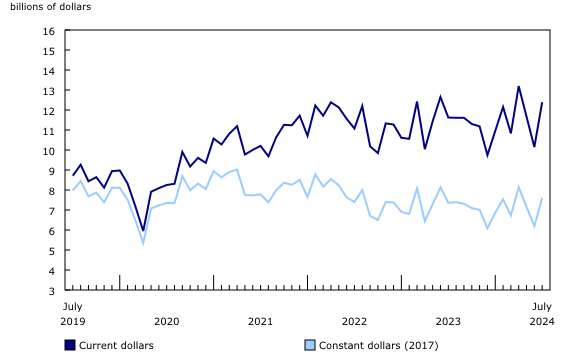
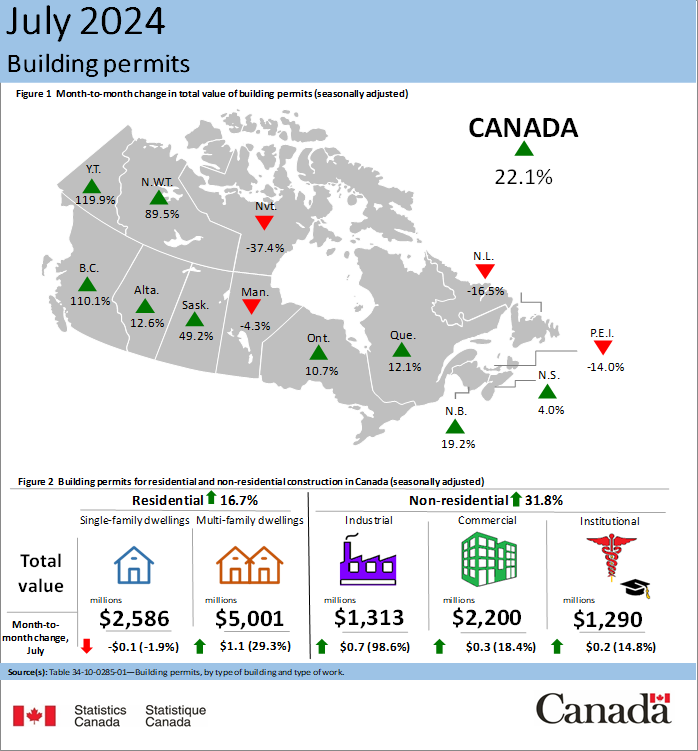
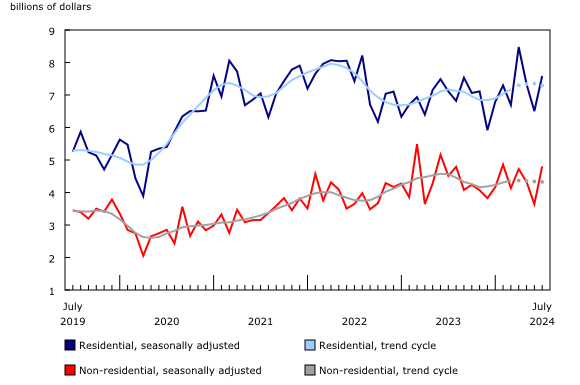
Month over month, the total value of building permits in Canada surged 22.1% to $12.4 billion in July, rebounding from two consecutive monthly declines. Both the residential and non-residential sectors expanded in July.
On a constant dollar basis (2017=100), the total value of building permits in July was up 22.9% compared with the previous month, while it rose 3.4% year over year.
Chart 1
Total value of building permits, seasonally adjusted
Infographic 1
Building permits, July 2024
Multi-unit construction intentions fuel growth in the residential sector
The total monthly value of residential permits increased 16.7% to $7.6 billion in July. The gains were driven by the multi-unit component (+29.3%; +$1.1 billion), while single-family construction intentions saw a modest decline (-1.9%; -$50.3 million).
In July, the value of permits issued in the multi-unit component (+29.3%) increased substantially to $5.0 billion, its second-highest monthly level on record after an all-time high of $5.9 billion in April. British Columbia (+152.1%; +$766.8 million) led the increase, with significant contributions from the City of Richmond. Alberta (+33.1%; +$141.0 million) and Ontario (+7.7%; +$122.6 million) were also major contributors to the growth in the multi-unit component.
Across Canada, 20,700 new dwellings in multi-unit buildings and 4,100 new single-family dwellings were authorized in July. From August 2023 to July 2024, a total of 266,200 new units were authorized.
Chart 2
Value of building permits for the single-family and multi-family components
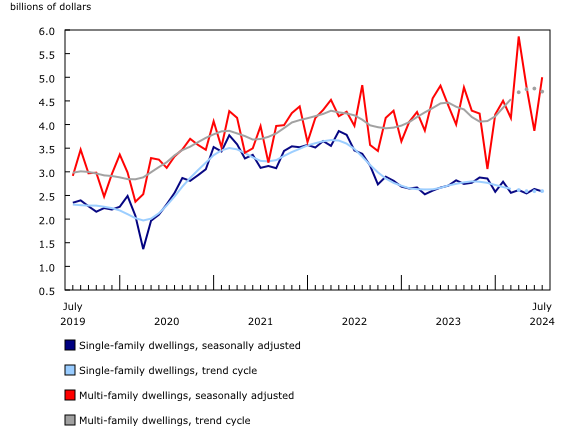
Chart 3
Value of building permits for the residential and non-residential sectors
Ontario and British Columbia lead gains in non-residential construction intentions
The total value of non-residential sector permits rose 31.8% to $4.8 billion in July. Overall growth in this sector was seen across the commercial (+18.4% to $2.2 billion), industrial (+98.6% to $1.3 billion) and institutional (+14.8% to $1.3 billion) components.
In Ontario, the non-residential sector grew 23.8% to $2.2 billion in July, driven by gains in the industrial component (+99.3%; +$338.0 million). The large monthly gains in Ontario’s industrial component pushed the value to a record-high level of $678.3 million in July. This was supported by construction intentions for the expansion of a tire manufacturing plant in Greater Napanee and broad-based growth throughout the province.
In British Columbia, the non-residential sector increased 99.2% to $869.1 million in July, with large gains in the industrial (+349.2%; +$168.4 million), institutional (+383.0%; +$157.6 million) and commercial (+30.8%; +$106.8 million) components.