Building Permits, April 2024
June 13, 2024
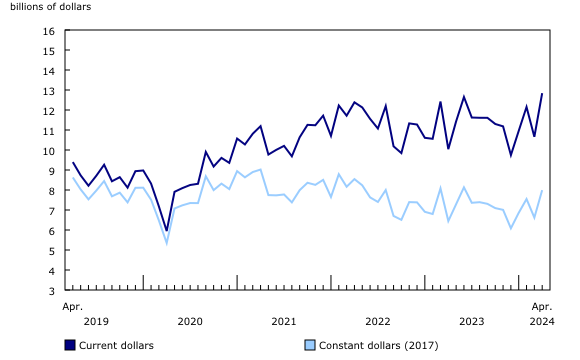
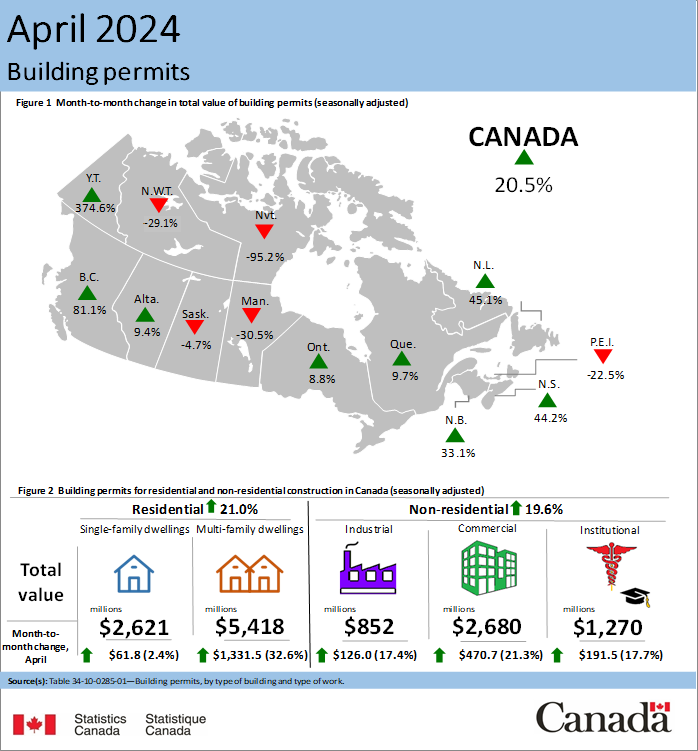
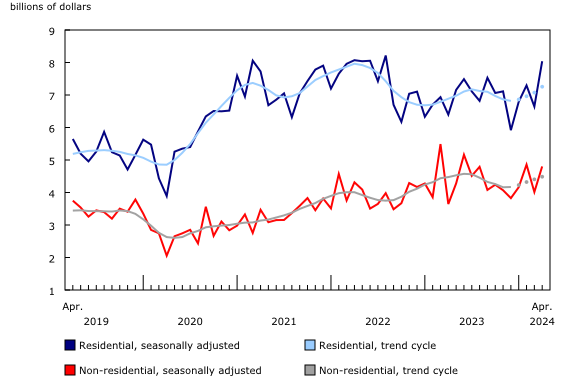
Month over month, the total value of building permits in Canada significantly increased 20.5% to $12.8 billion in April. Construction intentions in the residential sector increased 21.0% to $8.0 billion and the non-residential sector rose 19.6% to $4.8 billion, with growth observed in all components. British Columbia posted a record high monthly total value of building permits ($3.1 billion), leading the monthly increases in both residential and non-residential sectors in Canada.
On a constant dollar basis (2017=100), the total monthly value of building permits grew 20.7% in April, to the highest level since June 2023.
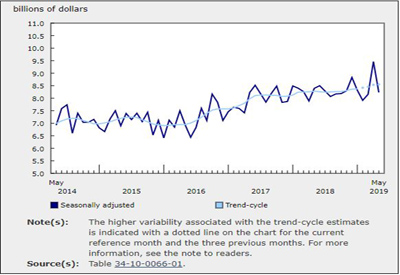
Chart 1
Total value of building permits, seasonally adjusted
Infographic 1
Building permits, April 2024
Record high levels in British Columbia’s multi-unit residential construction intentions
The value of residential building permits increased 21.0% to $8.0 billion in April 2024. The growth in the residential sector was driven by record high levels in the multi-unit component, increasing 32.6% to $5.4 billion, while the single-family home component edged up 2.4% to $2.6 billion.
British Columbia (+75.2%; +$796.3 million) led the growth in the multi-unit component, reaching a record high of $1.9 billion in April, surpassing the previous peak of $1.5 billion in June 2023. In April 2024, Ontario (+31.9%; +$442.9 million) also supported the monthly growth in the component. Overall growth was driven by several significant permits issued for multi-unit construction projects in the cities of Toronto, Ontario; Surrey, British Columbia; and Coquitlam, British Columbia.
Across Canada, 4,300 new single-family homes were authorized in April. Meanwhile, 22,600 new multi-unit dwellings were also approved through building permits, an all-time high. British Columbia’s record 7,200 new multi-unit dwellings authorized in April greatly contributed to this movement.
Despite a strong month, the 12-month cumulative total of 267,700 units authorized from May 2023 to April 2024 saw little change, increasing by 200 (+0.1%) units compared to the 267,500 units authorized from May 2022 to April 2023.
Chart 2
Value of building permits for the single-family and multi-family components
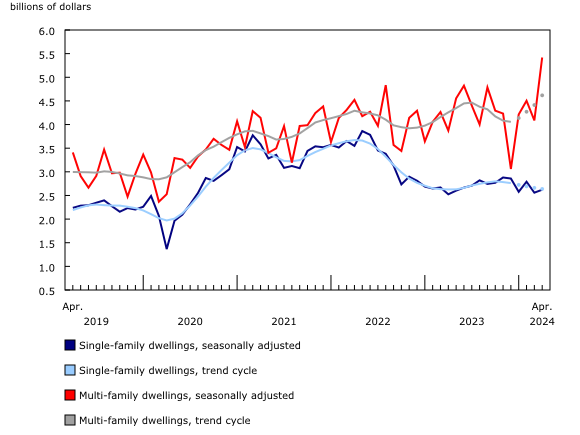
Chart 3
Value of building permits for the residential and non-residential sectors
British Columbia drives growth in the non-residential sector
The value of non-residential permits increased 19.6% to $4.8 billion in April 2024, with growth in the commercial (+21.3%; +$470.7 million), institutional (+17.7%; +$191.5 million) and industrial (+17.4%; +$126.0 million) components. Broad-based growth in British Columbia (+149.9%; +$605.6 million) drove the increase in the non-residential sector in Canada.