Wholesale Sales Value and Volume Dip in September
November 29, 2016
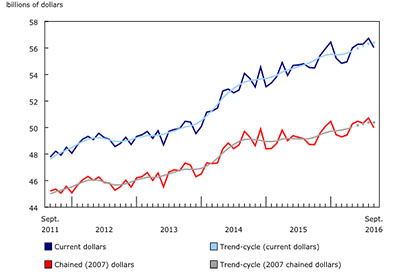
Wholesale sales decreased 1.2% to $56.0 billion in September, following increases in four of the previous five months. Declines were recorded in five subsectors, led by lower sales in the machinery, equipment and supplies, and the miscellaneous subsectors.
In volume terms, wholesale sales decreased 1.5% in September.
The machinery, equipment and supplies subsector recorded the largest decline in dollar terms in September, down 4.0% to $10.9 billion, its lowest level since April 2016. In September, three out of four industries posted declines, led by the other machinery, equipment and supplies (-7.8%) and the computer and communications equipment and supplies (-4.6%) industries.
Sales in the miscellaneous subsector declined 3.1% to $7.0 billion, following a 4.6% increase in August. While four of five industries reported declines, an 8.0% decrease in the agricultural supplies industry contributed the most to the downturn in September.
Following no change in August, the food, beverage and tobacco subsector reported a 1.1% decline to $10.8 billion, led by the food industry (-1.3%).
The motor vehicle and parts subsector rose 0.7% to $11.1 billion, following a 0.2% decrease in August. Declines in the new motor vehicle parts and accessories (-4.9%) and used motor vehicle parts and accessories (-8.3%) industries were outweighed by gains in the motor vehicle industry (+2.2%), which reached a record high $8.9 billion in September. Motor vehicle manufacturing sales also increased in September.
The personal and household goods subsector rose 0.8% to $8.2 billion, on the strength of gains in half of the industries in the subsector.
Sales down in all provinces
Sales declined in every province in September. Ontario, Alberta and Quebec accounted for 82% of the decrease in wholesale sales.
After three consecutive record-setting months, Ontario posted a 0.7% decline to $28.9 billion. This was the first decrease in the province in six months. Declines in the machinery, equipment and supplies subsector outweighed gains in the motor vehicle and parts subsector.
Alberta recorded the second largest decline in dollar terms, down 3.0% to $6.1 billion in September. This decrease marked the second lowest level in the province since September 2011. Declines were reported by six of the seven subsectors, led by the miscellaneous subsector and the motor vehicle and parts subsector.
Wholesale sales in Quebec fell for a second consecutive month, down 1.8% to $10.1 billion. Lower sales in the machinery, equipment and supplies subsector accounted for over half of the decrease in the province.
British Columbia (-0.9%) and Nova Scotia (-4.4%) saw widespread declines, led by the motor vehicle and parts subsector. Wholesale sales declined in British Columbia for the second time in three months, while Nova Scotia posted its sixth decrease in 2016.
After increasing four times in five months, sales in Saskatchewan declined 1.1% to $2.1 billion. Despite the decline, sales in the province were at their second highest level since December 2015.
Sales in Manitoba declined 0.3% to $1.4 billion in September, following a 1.9% gain in August.
Newfoundland and Labrador (-0.9%), New Brunswick (-0.6%) and Prince Edward Island (-2.4%) all recorded declines.
Inventories increase
Wholesale inventories edged up 0.2% to $72.1 billion in September, a second consecutive advance. Increases were recorded in six of seven subsectors, which together represented 88% of wholesale inventories.
In dollar terms, the building material and supplies subsector (+1.4%) recorded the largest gain, as inventories rose in all industries. The personal and household goods subsector (+0.4%) also reported higher inventories.
Inventories in the motor vehicle and parts subsector (+0.3%) increased for the fourth consecutive month, reaching their highest level on record in September.
Inventories in both the machinery, equipment and supplies (+0.1%) and the food, beverage and tobacco (+0.2%) subsectors edged up for the second consecutive month. This was the second gain in 11 months for the machinery, equipment and supplies subsector and the eighth gain in 11 months for the food, beverage and tobacco subsector.
The miscellaneous subsector (-2.0%) posted the lone decline, bringing inventories in the subsector to their lowest level since November 2014.
The inventory-to-sales ratio rose from 1.27 in August to 1.29 in September. This ratio is a measure of the time in months required to exhaust inventories if sales were to remain at their current level.
Source: Statistics Canada, www.statcan.gc.ca/daily-quotidien/161121/dq161121a-eng.htm