Committee Studies Combines Act — 1969
November 26, 2020
The pros and cons of joining the Canadian Electrical Association were first considered in 1969: no firm decision was made. Membership was purchased in the Canadian Tax Foundation.
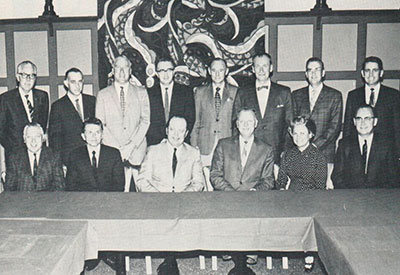
Federal combines legislation imposed at the time was proving burdensome and impractical, so a committee was set up with this mandate: “study the problems created in our industry by the combines legislation and suggest possible solutions to alleviate the restrictions and bad business practices that burden our industry.”
To aid the General Manager in determining his duties and responsibilities, the Board drew up numerous recommendations. These included: representing the Association in Ottawa, arranging workshops, running the affairs of CEDA office, and to inform the suppliers and customers of CEDA members what the association represents in the electrical industry.
The registration fee for attending the annual conference at the Harrison Hot Springs, British Columbia, was shown as being $35 per delegate; however they expected to lose money on the conference and to break even they really needed a registration fee of $42 per delegate.
Norman McKellar was introduced to the members at the conference as the new CEDA General Manager.
A re-occurring theme that runs through the deliberations of CEDA over many years is good relations with suppliers. In 1969, CEDA was particularly concerned that information go to suppliers for the 1970 conference, recorded as follows: “The Convention Committee was instructed to set up a facility to invite on a personal basis the top executives of the manufacturers and suppliers to the convention, whilst at the same time not excluding other representatives of these companies.”
On January 1, 1969, the Province of Ontario adopted a new minimum wage for general industry: $1.30 per hour, an increase of 30%. The new rate in the construction industry was raised to $1.55 per hour. At that time, Ontario’s rates became the highest in any province in Canada. Also in 1969, Alcan Universal Homes became the first company whose factory assembled homes received C.S.A. certification on the plumbing and electrical systems.
Source: CEDA: Fifty Years of Service – An Historical Review of the Canadian Electrical Distributors Association, 1934 to 1984, Kerrwil Publications. Please feel free to reach out to us any time if you have great photos, historical anecdotes or perspectives. We would love to hear from you; linegoyette@kerrwil.com.